Mount Fuji Mountain Hut Reservation: How Booking Actually Works
A mount fuji mountain hut reservation is the single most important booking on the whole trip, because in 2026 it is also what gets you through the trail gate after 2 p.m. Every hut runs somewhere between ¥10,000 and ¥17,600 a night with two meals included, the good ones on popular dates sell out weeks ahead, and turning up without one no longer just means a rough night, it means a locked gate. This guide covers what a hut night actually costs, what it is really like to sleep on the mountain, how and when to book, and what your real options are if every hut on your date is already full.
Quick answer
Book a Mount Fuji mountain hut from early May for your climbing dates, expect to pay ¥10,000 to ¥17,600 (about $63 to $111) per person with dinner and breakfast included, and treat the reservation as mandatory: without one, all four trails close to you from 14:00 to 3:00 the next morning.
Key takeaways
- Book from early May for the best choice of huts, especially for Saturday or Obon-week nights
- A typical hut night costs ¥10,000-17,600 ($63-111) with two meals; semi-private space adds ¥2,000-5,000
- No hut reservation means the trail gate closes to you 14:00-3:00; hut guests are exempt from that rule
- Sleep is basic: shared bunk rows, lights out around 20:00-21:00, a 1-2 a.m. wake for the summit push
- Most huts are cash-preferred or cash-only, so carry yen, not cards
- If every hut is booked on your date, a guided two-day tour that already holds hut allocations is the realistic fallback
Why a Hut Reservation Is Effectively Mandatory in 2026
Fuji's 2026 rules changed the calculation on hut bookings. All four trails now close their gates from 14:00 to 3:00 the following morning to anyone who does not hold a mountain hut reservation, a rule aimed squarely at bullet climbing, the practice of summiting in one non-stop overnight push without resting on the mountain. Show up at the 5th station at 3 p.m. with no hut booked, and the gate simply will not let you through until after 3 a.m.
On the Yoshida trail there is a second reason to book a hut: climbers with a confirmed hut reservation are exempt from the daily cap of 4,000 climbers, which is otherwise split between 3,000 advance slots and 1,000 same-day spots. A hut booking is not just where you sleep, it is what removes you from that daily lottery entirely. The ¥4,000 (about $25) trail fee is a separate charge, paid to the prefecture rather than to the hut, and it applies on top of whatever you pay for the bed; our full Mount Fuji cost breakdown shows where the hut and the fee sit in a complete climb budget.
What a Night in a Fuji Hut Actually Costs
Prices climb with altitude and with how close your date sits to a weekend or Obon. All figures use the ¥158/USD rate as of August 2026.
| Station level | Typical price with 2 meals | Notes |
|---|---|---|
| 7th station | ¥10,000-13,000 ($63-82) | Lower on the mountain, more huts to choose from |
| 8th station | ¥12,000-16,000 ($76-101) | The standard stop for a sunrise push, books up first |
| Near-summit (3,740m) | ¥14,000-17,600 ($89-111) | Fewest beds on the mountain, highest demand |
| Semi-private add-on | +¥2,000-5,000 (+$13-32) | Curtained compartment, only where offered |
Weekend and Obon-week (August 13-16) nights run toward the top of every one of these ranges, sometimes above it, while a Tuesday or Wednesday in late July or late August tends to land closer to the low end. Most huts are cash-preferred or outright cash-only, so carry enough yen for the night rather than assuming a card will work, and remember the ¥4,000 trail fee is billed separately from whatever you pay the hut.
What a Hut Stay Is Really Like
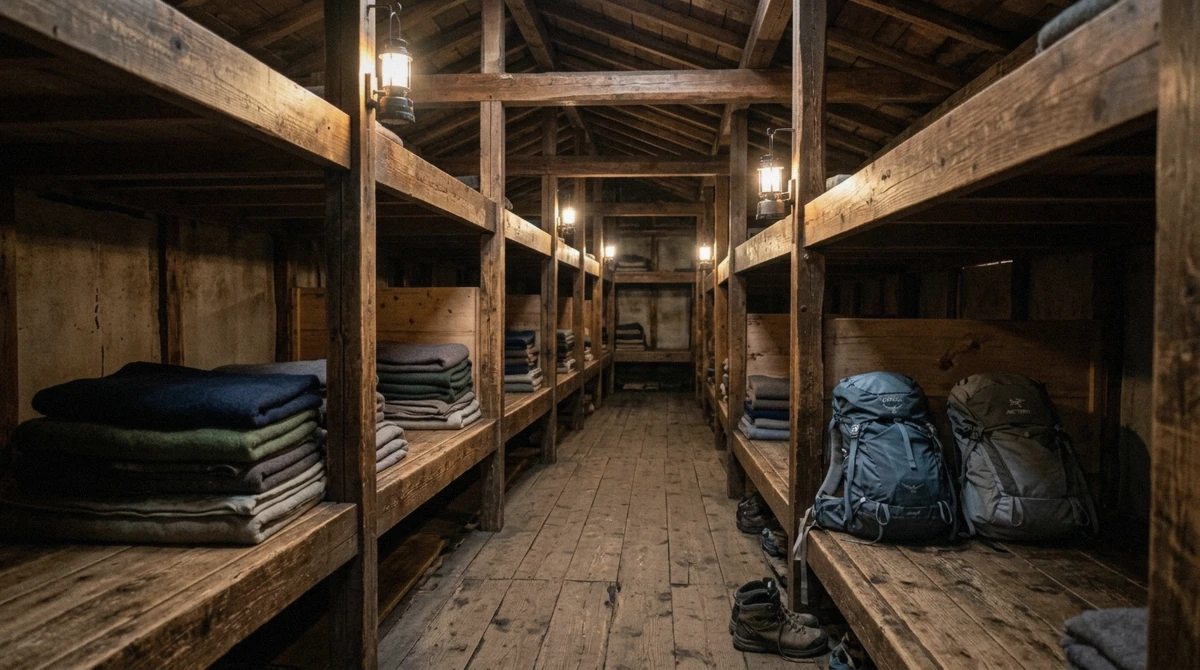
It is worth being honest about this before you book: a Fuji hut is not a hotel, and it is not meant to be. Sleeping space is a long wooden platform divided into numbered berths, close enough that your neighbor's shoulder is often a few centimeters away, with a shared blanket or sleeping bag and, at best, a thin curtain divider if you have paid for semi-private space. Lights go out early, around 20:00 to 21:00, because most guests are woken again in the middle of the night for the summit push, and the walls are thin enough that the hut rarely goes fully quiet.
Dinner is typically curry rice, served in one seating not long after you arrive, and breakfast is often handed out as a bento box for the pre-dawn start rather than served at a table. Bring earplugs and, if you sleep lightly, an eye mask; both make a real difference on a night with this little privacy. None of this is a complaint so much as a fair warning: the hut exists to get you rested enough for the summit push, not to be comfortable in its own right.
A Hut-Night Climb, Hour by Hour
Timing shifts slightly by hut and by season, but this is the rhythm most 8th-station stays follow.
-
Afternoon
Arrive and check in
Arrive well before the 14:00 gate cutoff; hut guests pass through regardless of the hour.
-
17:00-19:00
Dinner
One seating, usually curry rice, served not long after you settle in.
-
20:00-21:00
Lights out
Shared bunk rows, thin walls, earplugs recommended.
-
1:00-2:00 a.m.
Wake for the summit push
A bento breakfast, warm layers on, headlamps out for the 2-3 hour climb to the crater rim.
-
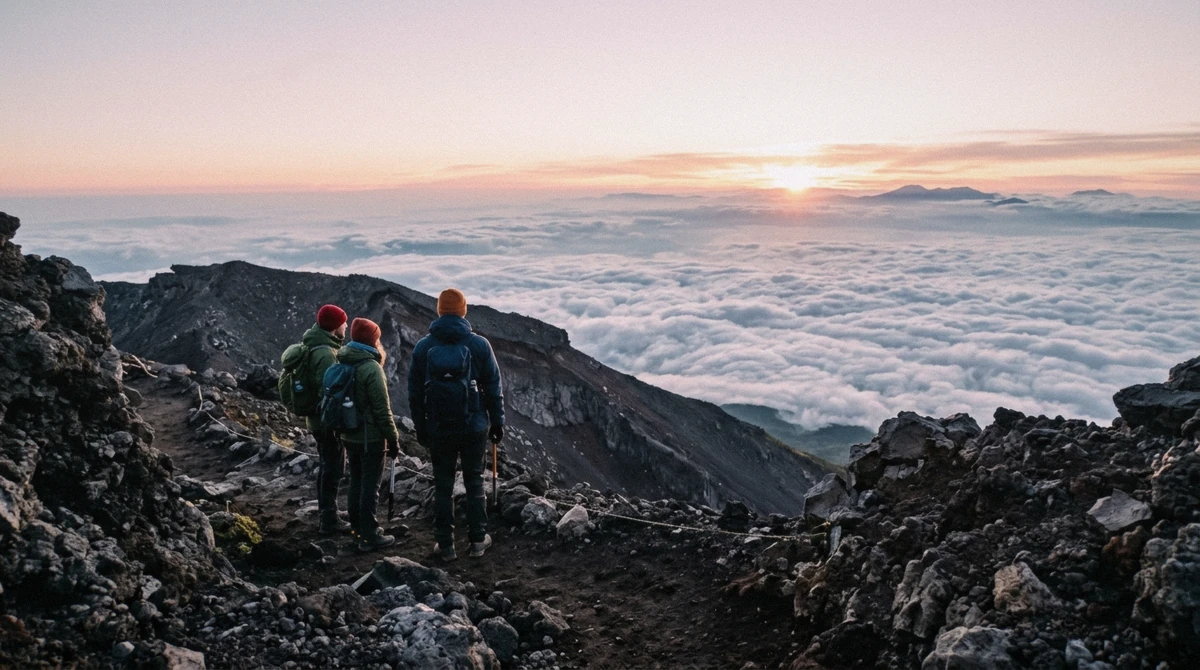
~4:30-5:10 a.m.
Goraiko sunrise
The exact time drifts across the season, from about 4:30 a.m. in early July to about 5:10 a.m. by early September.
How and When to Book
Hut reservations for the coming season generally open around early May, either directly through each hut's own website or phone line, or through the Yoshida trail hut association for huts on that route. Booking early matters most for anyone targeting a Saturday night or any night inside Obon week, August 13-16, 2026: those dates are consistently the first to disappear from every hut's calendar.
| When | What happens |
|---|---|
| Early May | Most huts open reservations for the 2026 season |
| Late May-June | Best selection of dates and room types still available |
| July | Weekday space still bookable; weekends tightening |
| Early August | Obon-week nights (Aug 13-16) frequently already full |
| Late August-September 10 | Weekday nights often re-open as the season winds down |
If you would rather not chase individual hut websites in Japanese, the guided two-day climbs with hut stays on this site book their hut allocation as part of the tour, which removes this whole step: the $238 lodge-stay climb sleeps at a lodge just below the rim, and the hut + onsen option adds a hot-spring stop on the way down. It is worth weighing before you commit to booking a hut yourself, since the trade-offs run both ways.
Which Station to Sleep At
The Yoshida trail carries the most huts of the four routes up Fuji, concentrated between the 7th and 8th stations, which is also why it is the easiest trail to book a hut on short notice and the default choice for most first-time climbers working out where to sleep. Subashiri huts sit on the same upper mountain once the two trails merge near the 8th station, while Fujinomiya and Gotemba run their own smaller sets of huts along their own lines. The real choice on any trail, though, is 7th station versus 8th station, and it comes down to a trade-off between acclimatization and how far you have to climb in the dark.
An 8th-station hut, typically 3,100 to 3,400 meters up, is the standard stop for a sunrise push, close enough to the crater that the pre-dawn climb runs a manageable two to three hours. Sleeping that high is also the single best thing you can do against altitude sickness, since spending a night at that elevation before the final push lets your body partly adjust before you go higher still, rather than climbing straight from sea level to 3,776 meters in one push. A 7th-station hut sits lower, so you get more genuine rest at an easier altitude with milder symptoms, but the final push to the summit takes longer and starts earlier to make the same sunrise. For most first-time climbers, the 8th-station trade-off is the more forgiving one, and it is the altitude band most guided two-day tours build their itinerary around.
No Reservation Left? Your Real Options
If your preferred date has no huts left, a few real options remain rather than gambling on the gate rule. First, check whether shifting to a weekday, even a day or two from your original plan, opens up availability, since demand drops off sharply outside weekends and Obon. Second, the Subashiri and Fujinomiya trails run fewer huts overall but can have space when Yoshida is fully booked, if the route itself works for your plan.
The most reliable fallback is a guided two-day climb where the operator already holds hut space as part of the package. The $238 summit-lodge hut stay and the $439 hut-and-onsen climb both include a reserved hut bed, meals and round-trip transport from Shinjuku, and because operators book their allocations well ahead of the general public, a tour can sometimes secure a hut on a date that looks fully sold out to an independent traveler searching hut by hut.
Hut Etiquette and Rules
A few rules are consistent across nearly every hut on the mountain, and knowing them before you arrive saves an awkward first few minutes:
- Shoes come off at the entrance; hut staff will point you to where to leave them
- Quiet hours start at lights-out, around 20:00-21:00, and other guests are trying to sleep before their own summit push
- Keep gear packed and off the walkways; bunk space is tight and shared
- Toilets cost ¥200-300 in coins, so keep small change on hand
- Water is bought, not free, and gets pricier the higher up the mountain you climb
None of these rules are unusual for a working mountain hut anywhere in the world, and hut staff are generally patient with first-time climbers who ask before assuming. The one habit worth building before you go: pack small change specifically for toilets and count on paying cash for everything from a bottle of water to the semi-private add-on, since a hut running out of change or card capacity mid-season is common enough that relying on a card is a real risk, not a theoretical one.
Timing It With the Rest of Your Climb
Your hut night is only one piece of the season-wide picture. If your dates are still flexible, our guide to the best time to climb Mount Fuji breaks the season down week by week, including exactly which weeks make huts easiest to book and which ones, Obon above all, make even the earliest booking a scramble.
Frequently Asked Questions
Can I just walk in and ask for a hut bed on the day?
Sometimes on a quiet weekday, but never count on it. Popular huts, especially at the 8th station, often sell out weeks in advance for peak July and August dates, and a walk-in on a Saturday or during Obon is a genuine gamble.
What is actually included in a hut price?
A shared bunk space and, in most cases, dinner and breakfast, typically curry rice for dinner and a bento for the pre-dawn breakfast. The price runs ¥10,000-17,600 depending on the station and the date; a curtained semi-private space costs ¥2,000-5,000 more where it is offered.
Do I actually sleep, or is it just a rest stop?
You get real sleep, though not much of it. Lights out is usually 20:00-21:00 and the wake-up for the summit push is typically 1:00-2:00 a.m., so expect four to five hours in the bunk rather than a full night.
What is the cancellation policy for a hut booking?
Policies vary by hut, and many are strict about short-notice changes, so confirm the specific terms directly with the hut when you book. A guided tour's hut allocation typically falls under the tour operator's own cancellation policy instead.
Can kids stay in a Mount Fuji hut?
Yes, huts accept children, though the shared, close-quarters sleeping arrangement and the 1-2 a.m. wake-up are worth weighing honestly against a child's stamina before booking.
Can I book a Mount Fuji hut in English?
Some huts, particularly the larger ones on the Yoshida trail, take English bookings online or by phone. For huts without an English option, a guided tour that holds its own hut allocation removes the language barrier entirely.
What if I don't book a hut at all?
Without a hut reservation, all four trails close to you from 14:00 to 3:00 the next morning, which rules out a same-day arrival much past early afternoon. A hut booking is what keeps that gate open for you outside those hours.